

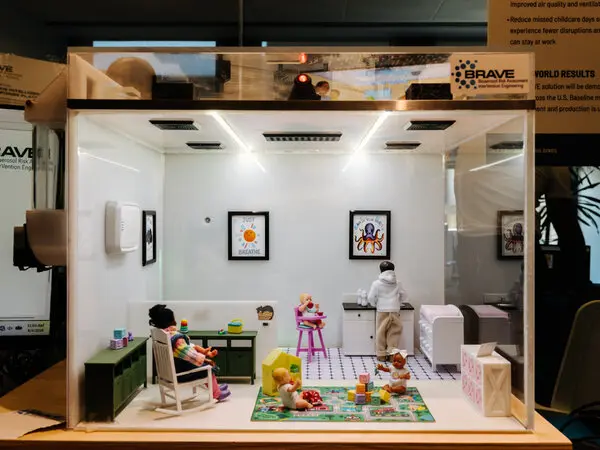
Indoor air quality has become an increasingly important consideration for businesses, schools, healthcare settings, hospitality venues and other shared environments. When large numbers of people use the same indoor space, airborne particles can accumulate, particularly where ventilation is limited or occupancy levels are high.
Viruses and bacteria can spread in several ways, including through direct contact, contaminated surfaces and respiratory particles released when people breathe, speak, cough or sneeze. Managing these risks requires a combination of good ventilation, appropriate hygiene practices, building maintenance and effective air filtration.
How Airborne Transmission Happens
Respiratory particles vary considerably in size. Larger droplets tend to settle relatively quickly, while smaller aerosols can remain suspended in the air for longer periods. These smaller particles may travel across rooms, especially where airflow carries them beyond the immediate area.
The likelihood of airborne transmission can be affected by several factors, including room size, ventilation rates, occupancy levels and the amount of time people spend together. A crowded meeting room with poor ventilation, for example, may present different risks from a large warehouse with strong airflow and fewer occupants.
Air filtration can help reduce the concentration of some airborne particles, but it should form part of a wider indoor air management plan rather than being treated as a complete solution.
What Are Virus and Bacteria Filters?

Virus and bacteria filters for business are filtration systems designed to capture very small airborne particles that may carry microorganisms. These systems are often used in workplaces and public buildings where maintaining indoor air quality is particularly important.
The filters do not necessarily target viruses or bacteria as isolated organisms. Instead, they capture the respiratory droplets, aerosols, dust and other particles to which microorganisms may be attached.
Performance depends on the type of filter, the volume of air passing through it and how effectively the system is matched to the room. A high-quality filter may offer limited benefits if the unit is too small, badly positioned or poorly maintained.
The Role of HEPA Filtration
High-efficiency particulate air filters, commonly known as HEPA filters, are widely used in air-cleaning systems. They are designed to capture a high proportion of fine particles as air passes through the filter material.
HEPA filters contain densely arranged fibres that trap particles through several physical processes. Larger particles may collide directly with the fibres, while smaller particles can be captured as they move unpredictably through the filter.
The filtration standard should be checked carefully, as not every product described as high efficiency meets the same specification. Organisations should also consider whether the complete air-cleaning unit prevents unfiltered air from leaking around the filter.
Ventilation and Air Filtration
Ventilation and filtration perform different functions. Ventilation introduces outdoor air and removes stale indoor air, helping to reduce carbon dioxide levels, odours and airborne contaminants.
Air filtration cleans air that is already circulating within the room. It can be useful where natural ventilation is inconsistent or where opening windows is not practical because of noise, weather, security concerns or outdoor pollution.
In many commercial environments, a combination of ventilation and filtration is more effective than relying on either approach alone. Existing mechanical ventilation systems should be maintained regularly, with filters inspected and replaced according to the manufacturer’s guidance.
Choosing the Right System for a Business
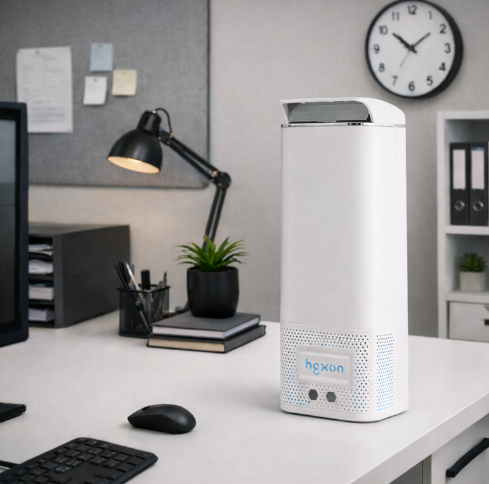
Room dimensions are an important consideration when selecting an air-cleaning system. Organisations should calculate the total volume of the space rather than considering floor area alone, particularly where ceilings are unusually high.
The clean air delivery rate can help indicate how much filtered air a unit provides. This figure should be considered alongside the intended number of air changes per hour.
Occupancy patterns also matter. A reception area with frequent visitors may require a different approach from a private office used by one person. Meeting rooms, classrooms and waiting areas may experience temporary periods of high occupancy and could require additional airflow during busy times.
Noise levels should also be reviewed. A system that is too loud may be turned down or switched off, reducing its practical effectiveness.
Correct Placement and Operation
Air-cleaning units need clear access to the surrounding air. Placing a purifier behind furniture, under a desk or close to a wall may restrict airflow and limit its performance.
The unit should be positioned so that filtered air can circulate throughout the occupied space. However, strong airflow should not be directed from one person towards another, as this could move respiratory particles across the room before they are filtered.
Where a room has an unusual shape or contains partitions, more than one unit may be needed. Businesses should also ensure that doors, vents and heating systems do not create unexpected airflow patterns.
Maintenance and Filter Replacement
Filters collect particles over time and gradually become clogged. As resistance increases, the system may move less air, even if the fan continues to operate.
Replacement intervals depend on operating hours, pollution levels and the type of environment. A filter used in a busy public building may need more frequent replacement than one in a lightly occupied office.
Maintenance staff should follow the manufacturer’s instructions when handling used filters. Appropriate protective equipment may be required, and filters should be disposed of carefully to avoid releasing collected material.
Supporting a Healthier Workplace
Air filtration is only one part of managing infection risks in commercial settings. Regular cleaning, effective ventilation, suitable sick leave policies and encouraging people to stay home when unwell can all contribute to reducing transmission.
Businesses should review how each part of the building is used and identify spaces where people gather for extended periods. Monitoring occupancy and ventilation performance can help organisations make informed decisions about where additional filtration may be beneficial.
A coordinated approach that combines airflow management, filtration, maintenance and workplace procedures can support healthier indoor environments without relying on a single measure.
