

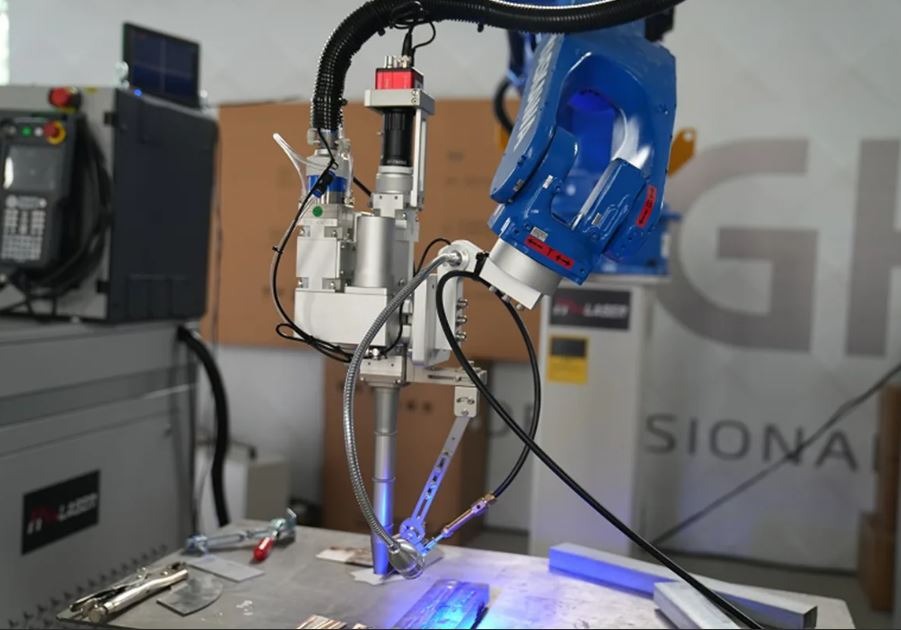
Manufacturers are constantly looking for ways to improve welding speed, consistency, and production efficiency. Traditional manual welding remains useful for many applications, but repetitive production work can create challenges related to labor availability, consistency, and cycle times.
A robot laser welding machine combines a focused laser beam with robotic movement to automate welding operations. The laser provides concentrated heat, while the robotic system controls the welding path and position with high repeatability. Laser welding is known for high welding speeds and relatively low heat input, which can help reduce thermal distortion.
What Is a Robot Laser Welding Machine?
A robot laser welding machine is an automated welding system that uses a robotic arm equipped with a laser welding head.
Instead of an operator manually guiding the welding tool along every joint, the robot follows a programmed path. The laser focuses energy into a small area of the workpiece, melting the material at the joint and creating the weld.
This combination is particularly useful for repetitive manufacturing applications where consistent weld positioning and process parameters are important.
How Does Robotic Laser Welding Work?
The process generally begins with accurately positioning the workpiece in a fixture.
The robot then moves the laser head along the programmed welding path. The focused beam creates concentrated heat at the joint, causing the material to melt and form a weld as it cools.
A typical system can include:
- Laser source
- Robotic arm
- Welding head
- Controller
- Positioning or fixturing system
- Shielding gas system
- Optional wire feeder
- Safety enclosure
- Monitoring equipment
Modern automated systems can also integrate sensing and monitoring technologies to improve process control.
High Precision and Repeatability
One of the biggest advantages of robotic laser welding is repeatability.
A programmed robot can follow the same path repeatedly, maintaining consistent movement and positioning across production cycles. This can be particularly valuable when manufacturing components with tight dimensional requirements.
Robotic welding automation is commonly used when manufacturers need consistent weld quality and higher throughput.
Faster Production
Laser welding can operate at high speeds because energy is concentrated into a small area.
When this process is combined with robotic automation, manufacturers can achieve consistent movement and repeatable production cycles.
A 2026 manufacturing case reported a fourfold productivity increase after a company moved from manual TIG welding to robotic laser welding, alongside reduced distortion and post-weld processing. Actual results, however, depend heavily on the application, material, joint design, and production setup.
Lower Heat Input
Traditional welding processes can introduce significant heat into the surrounding material.
Laser welding concentrates energy close to the joint, which can reduce the size of the heat-affected area and minimize distortion in suitable applications.
This characteristic can be particularly useful when working with thin or precision components where excessive heat could cause warping.
Reduced Post-Weld Processing
A controlled laser weld can produce a narrow and clean seam.
Depending on the application and required appearance, this may reduce the amount of grinding, polishing, straightening, or other finishing work required after welding.
Less post-processing can contribute to shorter production cycles and lower labor requirements.
Materials Suitable for Laser Welding
Laser welding can be used with a wide range of metals.
Common applications include steel and aluminum, while modern laser systems can also support challenging materials such as copper and copper-aluminum combinations when appropriate laser sources and process parameters are used.
Material thickness, reflectivity, joint design, surface condition, and laser power all need to be considered before selecting the process.
Industrial Applications
Robot laser welding is used across several manufacturing sectors.
Automotive
Automotive manufacturers can use robotic laser welding for components requiring repeatable, high-speed joining.
Electronics
Precision laser welding can be useful for small components and assemblies where controlled heat input is important.
Aerospace
Aerospace manufacturing requires high-quality and repeatable joining processes for many specialized components.
Metal Fabrication
Manufacturers producing cabinets, frames, enclosures, and other metal products can use robotic systems to automate repetitive welds.
Battery Manufacturing
Laser welding is also used for certain battery-related applications, including joining components where controlled heat input and precise weld placement are important.
Important Factors Before Automation
A robot laser welding machine is not automatically the right solution for every welding job.
Parts should have consistent dimensions, accurate fixturing, and repeatable joint locations. Production volume should also justify the investment in automation.
For irregular one-off work or applications with unstable gaps and constantly changing part geometries, manual or other welding methods may remain more practical.
Final Thoughts
A robot laser welding machine brings together laser precision and robotic repeatability to create a highly automated welding process.
Its potential advantages include high production speeds, consistent weld paths, low heat input, reduced distortion, and less post-weld processing.
For manufacturers considering automation, the best results come from evaluating material type, joint design, production volume, component consistency, laser power, fixturing, and overall production requirements before selecting a system.
