

Applying for a loan involves more than completing an application and choosing an amount. Lenders need documents to confirm who you are, where you live, what you earn and whether you can repay the borrowed amount. These checks also help lenders meet regulatory requirements and assess the risk associated with an application.
The Reserve Bank of India (RBI) requires regulated entities to follow customer identification and due-diligence procedures under its KYC framework. However, the exact documents requested can differ between lenders and loan products.
It is useful to distinguish between KYC documents and financial documents. KYC documents establish identity and address, while financial documents help lenders understand income, existing obligations and repayment capacity. Before applying, applicants should always check the lender’s latest document checklist because requirements may change based on the loan type, employment status, amount requested and individual lender policies.
What Documents Are Required for a Loan in India?
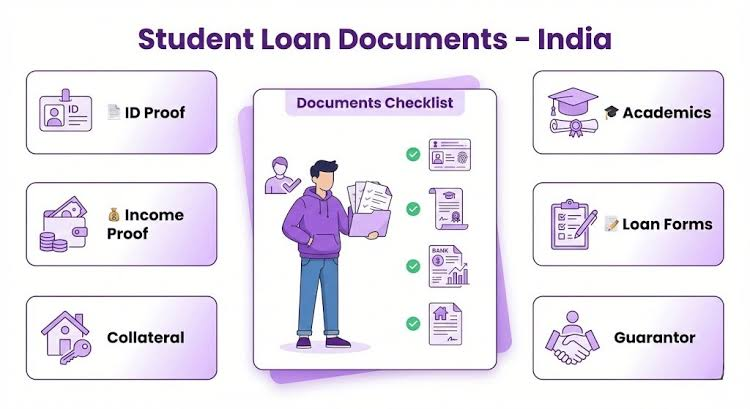
Most loan applications require a combination of identity, address, financial and application-related documents. Common requirements include-
- Identity proof- PAN, passport, driving licence or voter ID is mandatory documents needed for identity proof.
- Address proof- Aadhaar, passport, utility bills or other accepted documents.
- Recent bank statements- Statements showing regular transactions and income credits.
- Income proof- Salary slips, ITRs, Form 16 or other relevant records.
- Passport-size photographs- Recent photographs as specified by the lender.
- Completed loan application form- Accurate personal, employment and financial details.
Not every applicant will need to submit every document listed above. The lender may accept specific alternatives or request additional records depending on the application.
Documents Required for Salaried Applicants
Salaried borrowers generally have a straightforward way to demonstrate regular income. Lenders may ask for the following-
- Latest salary slips showing recent earnings and deductions
- Form 16 or ITR documents for income verification
- Recent bank statements showing salary credits and transactions
- Employee ID or employment-related identification
- KYC documents for identity and address verification
Keeping these records consistent is important. For example, differences in the name or address across documents may require clarification before the application can move forward.
Documents Required for Self-Employed Applicants
Self-employed applicants usually need to provide more detailed financial information because their income may vary from month to month. Typical requirements include-
- ITRs covering the relevant financial assessment period
- Balance sheets showing the financial position of the business
- Profit & Loss statements showing business income and expenses
- Business address proof for confirming the operating location
- Business registration documents, where applicable
- Bank statements showing business-related financial activity
Depending on the nature and size of the business, a lender may also request additional financial or ownership-related documents.
Documents Required for Different Types of Loans
The documentation needed can change considerably depending on the purpose of borrowing. A secured loan, for example, may involve documents relating to the asset being financed.
Personal Loan
A personal loan generally requires documents that establish identity and demonstrate regular income. Applicants may need-
- KYC documents
- Income proof
- Salary slips or ITR documents
- Recent bank statements
For someone seeking a Personal loan in Ahmedabad, for example, the lender’s checklist should be reviewed before submitting the application, as documentation can vary by provider and applicant profile.
Business Loan
Business borrowers usually need both personal KYC documents and records relating to their enterprise. These can include-
- KYC documents
- ITRs
- Business registration documents
- Financial statements
- Recent bank statements
For applicants considering a Business loan in Ahmedabad, having business and financial records organised can make the documentation stage easier and help avoid repeated requests for information.
Home Loan
Home loans involve income verification as well as property-related checks. Common documents include-
- KYC documents
- Income documents
- Recent bank statements
- Property-related documents
Property papers can vary depending on the property and transaction, so applicants should confirm the exact requirements with the lender.
Why Do Lenders Ask for These Documents?
Documentation allows lenders to establish whether the information provided in an application is accurate and sufficient for assessment. Under the RBI’s KYC framework, regulated entities are required to carry out customer identification and due diligence.
The documents also help lenders-
- Verify the applicant’s identity and residential address
- Confirm income and employment or business details
- Assess whether the applicant can manage repayments
- Complete applicable KYC and customer due-diligence requirements
- Evaluate credit risk before approving the application
Financial records can therefore play an important role in determining whether the requested loan amount is suitable for the applicant.
How to Prepare Your Documents Before Applying
A little preparation can prevent delays during the application process. Before submitting your documents-
- Keep all documents valid, current, and easily accessible
- Ensure names and personal details match across documents
- Maintain clear, readable digital copies of required records
- Keep recent bank statements ready for quick submission
- Check the lender’s latest document checklist before applying
- Never submit altered, incomplete or inaccurate documents
If a document contains outdated information, resolve the discrepancy where possible before starting the application. Also, submit documents only through the official application channel of the lender to protect sensitive personal and financial information.
Conclusion
Loan documentation generally falls into a few major categories- KYC and identity records, address proof, income documents, bank statements and loan-specific paperwork. Salaried and self-employed applicants may have different financial documentation requirements while personal, business and home loans can involve additional records.
There is no single document list that applies to every borrower. Requirements can change according to the lender, loan type and applicant profile. Checking the current checklist of the lender before applying helps ensure that the required documents are available, accurate and ready for submission that makes the application process more organised and reduces avoidable delays.
