

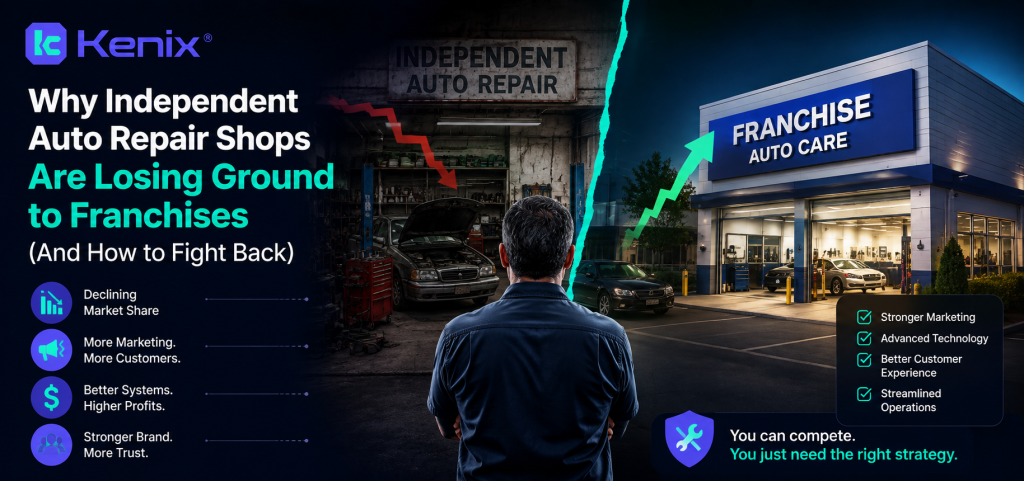
Walk into any owner meeting at an industry conference and you’ll hear some version of the same conversation. A Midas or a Christian Brothers Automotive opened three miles down the road. A good technician just left for a franchise that offered a signing bonus and a set schedule. A longtime customer mentioned they tried the new place because it popped up first on Google.
None of this is paranoia. The independent auto repair shops vs franchises tension is a real, measurable shift playing out bay by bay across the industry, and independent shop owners deserve a straight answer about what’s driving it and what they can actually do about it.
Independent Auto Repair Shops vs Franchises: The Numbers Behind the Shift
Industry research firm IBISWorld has tracked this pattern closely. Its analysis of the auto mechanics industry notes that as costs have risen and older shop owners have retired, franchises have been taking over and commanding a larger share of the market. Newly certified technicians increasingly gravitate toward franchises and larger chains, drawn by more predictable schedules and steadier demand.
The money backs this up. Private equity firms, including names like Roark Capital, Leonard Green & Partners, and Audax Group, poured an estimated $4.8 billion into the auto services category in 2024 and 2025 alone. A lot of that capital goes toward buying franchised units directly from retiring independent operators, which tightens the supply of available territory and pushes valuations higher.
Add in labor costs. Technician wages rose roughly 14 percent between 2023 and 2025, according to the Bureau of Labor Statistics. Franchises, with national vendor agreements and shared back-office systems, absorb that kind of cost increase more easily than a single shop with three bays and one owner doing the books at night.
Franchised locations still only make up around 18 percent of total U.S. service bays, a minority of the industry. But that share is growing steadily, and it’s growing specifically by absorbing the businesses independents built.
Why Franchises Are Winning Right Now
It helps to be honest about what franchises actually offer, because pretending they don’t have real advantages doesn’t help anyone fight back effectively.
Buying power. National vendor agreements mean lower parts costs per unit than most independents can negotiate alone.
Marketing budgets. A regional or national ad campaign reaches more eyeballs than a single shop’s Facebook page ever will, and franchise fees fund exactly that.
Standardized experience. Every visit looks and feels the same, which some customers find reassuring even if it isn’t better work.
Warranty backing. A nationwide warranty feels safer to a customer who’s about to move states or just doesn’t know who to trust.
Technician stability. Set schedules, structured training ladders, and predictable pay attract younger techs who watched their parents grind through unpredictable independent-shop hours.
None of that means the work is better. It usually isn’t. But customers and technicians don’t always choose based on who does the best diagnostic work. They choose based on who feels like the safer bet.
What Independent Shops Still Have Going for Them
Here’s the part that gets lost in the doom and gloom. Independent shops still make up the majority of the auto repair industry, and the ones that are thriving usually aren’t losing to franchises on quality. They’re often winning on it.
Community trust is real and it compounds. A customer who’s brought three cars to the same shop over ten years, who knows the owner by name, who got a fair price on a repair that could have been oversold, tells other people about that. Franchises can buy attention. They can’t buy that kind of word of mouth.
Flexibility is real too. An independent owner can approve a judgment call, cut a longtime customer a break, or take on an odd specialty job that a franchise’s corporate playbook won’t allow a manager to touch. That flexibility is a competitive edge, not a weakness, when it’s used well.
How to Fight Back: Moves That Actually Work
Complaining about franchise money doesn’t change anything. Here’s what actually helps independent shops compete with franchise auto shops.
Systemize what franchises systemize, without losing what makes you independent. Franchises win partly because every customer interaction follows a playbook: consistent follow-up, consistent review requests, consistent scheduling reminders. Independent shops can match that consistency with the right auto repair shop technology, call tracking, automated appointment reminders, review request workflows, without needing a corporate office to run it. The goal isn’t to feel like a chain. It’s to stop losing business to gaps a franchise wouldn’t have.
Own your local search presence. A franchise’s national domain authority can outrank a weak local listing. It usually can’t outrank a shop with dozens of specific, recent, detailed reviews and a well-maintained Google Business Profile. This is one of the few areas where a small operation genuinely competes with a chain’s ad budget for close to nothing.
Plug the revenue leaks that quietly hurt margins. Missed calls, no-shows, and declined estimates that never get followed up on all add up to real money walking out the door, money that franchises are more disciplined about capturing simply because they built processes around it. Closing that gap doesn’t require a franchise-sized budget, just better follow-through.
Retain technicians on purpose. If franchises win talent with structure, match the structure without the corporate ceiling. Clear pay tiers, a real training path, predictable scheduling where possible, and a shop culture people don’t want to leave. Independent mechanic growth, both for the business and for the people in it, tends to follow shops that invest in their techs as seriously as they invest in equipment.
Go where franchises can’t easily follow. EV and hybrid diagnostics, European makes, fleet accounts, or other specialty work often require training and equipment investment that a standardized franchise model is slower to adopt across every location. A shop that specializes has a moat a generic chain doesn’t.
Join a buying group. Independent shops don’t have to negotiate parts pricing alone. National and regional buying groups exist specifically to give independents franchise-level purchasing power without giving up ownership or paying royalties.
Plan your exit before the market plans it for you. A lot of independents end up selling to a roll-up simply because they never built another option. Mentoring a manager toward ownership, exploring an employee buyout, or at minimum having a real valuation and succession plan means a sale happens on your terms, not because a consolidator’s offer was the only one on the table.
The Real Advantage Independents Have
Franchises can copy a process. They can’t copy twenty years of a customer trusting the person who answers the phone. The shops losing ground usually aren’t losing because independents can’t compete. They’re losing because they’re competing with one hand tied behind their back, doing excellent work but leaking customers through gaps a little more structure would close.
Frequently Asked Questions
Are franchises really taking over the auto repair industry?
Not entirely. Independent shops still represent the majority of the industry. But franchises are growing their share steadily, largely by acquiring retiring owners’ businesses and absorbing new customers who value standardization and marketing reach.
Why are technicians choosing franchises over independent shops?
Mostly for structure: predictable schedules, defined pay tiers, and clearer training paths. Independent shops that offer similar structure, even at a smaller scale, remain highly competitive for talent.
Can a small shop realistically compete with a franchise’s marketing budget?
Not dollar for dollar, but local search and reviews level the field more than most owners realize. A strong local reputation often outperforms broad brand advertising for actual foot traffic.
What’s the single biggest advantage independent shops still have?
Trust built over years of personal relationships. It’s the one thing a franchise’s marketing budget genuinely cannot buy.
The Bottom Line
The franchise squeeze is real, and pretending otherwise doesn’t serve any shop owner. But the shops actually losing ground aren’t losing because independents can’t compete on quality or trust. They’re losing because a franchise down the street is simply more consistent about following up, showing up in search results, and not letting a customer slip through the cracks. Close that gap, and the trust an independent shop has spent years earning becomes the advantage it should have been all along.
