

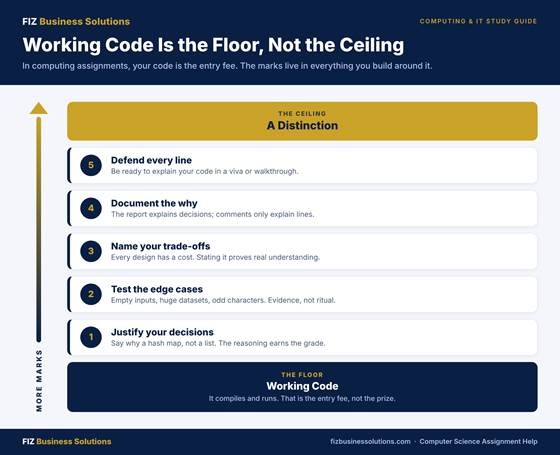
Every computing cohort shares the same quiet frustration. One student writes a program that compiles on the first attempt, passes every test, and still comes back with a 58. Another hands in messier code and lands a first. After years of guiding computing students through FIZ Business Solutions, I can tell you that gap has little to do with raw talent. It points to the most useful thing to understand about how computing work is assessed. Your code is the entry fee. It is not the prize.
Markers rarely award the top band for a program that simply runs. They award it for evidence that you understood what you built, why you built it that way, and what you would change next time. Once you see assignments through that lens, your whole approach shifts.
The report is the real deliverable
In most computing modules the written report carries more weight than the code, yet students pour most of their time into the implementation and write the report in a panic the night before. The result is a document that describes features instead of defending them.
Take a small decision: storing user records in a hash map rather than a list. A mid-band report says, “I used a hash map.” A first-class report says, “I chose a hash map because lookups by user id dominate this workload and needed to stay close to constant time, where a list would have forced a linear scan.” Same code, very different mark. The grade lives in the sentence that explains the choice.
Testing is an argument, not a checkbox
Running your code with the single input the brief provides proves almost nothing. The marks appear when you test the cases that try to break it. What happens with an empty file, a negative number, a name containing an apostrophe, or a dataset ten times larger than expected. Each of those is a small argument that you understand where your program is fragile.
Keep a short table of what you tested, what you expected, and what actually happened, including the cases that failed before you fixed them. That table is some of the easiest credit in the whole assignment, and most students never produce it.
Name your trade-offs out loud
There is no perfect design, only decisions with costs. Normalising a database to third normal form keeps it clean but can slow certain queries. Agile suits a shifting brief but needs a discipline a solo student rarely has. A recursive solution reads elegantly but can exhaust the stack on large input. When you name the cost of your own choice, you signal the exact thing a marker is trained to reward: that you understand the subject deeply enough to see what you gave up.
Comments and documentation do different jobs
A quiet source of lost marks is treating code comments and report documentation as the same task. They are not. A comment sits next to a line and explains how that line works, often for a future version of you. Documentation sits in the report and explains why the system was built this way, for a reader who may never open the source. A marker reads both. Weak submissions fill the code with comments that restate the obvious, such as “this loop adds the numbers”, while the report stays thin on reasoning. Strong submissions keep comments sparing and precise, then save the real thinking, the why and the trade-off, for the report where the marks actually live.
Debug in a way you can write about
When something breaks, resist the urge to change lines at random until it works. Read the actual error message first, then reproduce the failure with the smallest input that still causes it. A program that crashes on a list of a thousand records but runs fine on three is telling you something specific about how it scales, and that observation belongs in your evaluation. Debugging slowly, and noting what you changed and why, turns a frustrating hour into a paragraph of genuine analysis. Markers can always tell the difference between a student who fixed a bug and a student who understood it.
Build so you can defend it
Many modules end with a viva or a code walkthrough where you must explain every line you submitted. This is where borrowed or half-understood work falls apart. Commit your code in small steps as you go, so your version history becomes a record of your own thinking. If a section still feels like a black box to you, that is the part to slow down on, because it is the part an examiner will ask about.
This is also where a second opinion earns its keep. Talking a confusing brief or a stubborn algorithm through with someone who knows the subject can turn a black box into something you can explain in your own words. Guided computer science assignment help matters most here, not to replace your effort, but to make sure you can stand behind every part of what you submit.
FAQ
My code works but my grades stay average. What am I missing?
Almost always the written justification. Markers reward the reasoning behind your code far more than the code itself, so explain every significant decision and the trade-off it carried.
How much of a computing mark is the report versus the code?
It varies, but in many modules the report and evaluation outweigh the implementation. Read your marking scheme, then budget your time to match the weighting rather than your instinct.
What loses the most marks in a software engineering report?
Describing what you did without explaining why. A feature list reads as a mid-band answer; a justified decision reads as a top-band one.
How do I prepare for a code walkthrough or viva?
Be able to explain every line in plain language, name one thing you would improve, and know exactly where your program is weakest. Being honest about your own limitations impresses examiners more than pretending there are none.
Is it worth adding diagrams if the brief does not ask for them?
Usually yes. A clear UML or data flow diagram communicates a design faster than a paragraph and signals that you think in structures, not only in syntax. Keep each diagram consistent with your text and your code, and refer to it directly when you explain a decision.
The real lesson
Treat the code as the start of the assignment, not the finish. The work that separates a pass from a distinction is the thinking you make visible around the code: the justification, the testing evidence, the honest evaluation. Get your program running early, then spend the time that remains proving that you understand it. That single habit carries from one module to the next, and eventually into the interview room.
About the author: Sajjad Akbar Ali is the founder of FIZ Business Solutions, which has supported university students across the UK and the Gulf with computing and academic work since 2015.
