

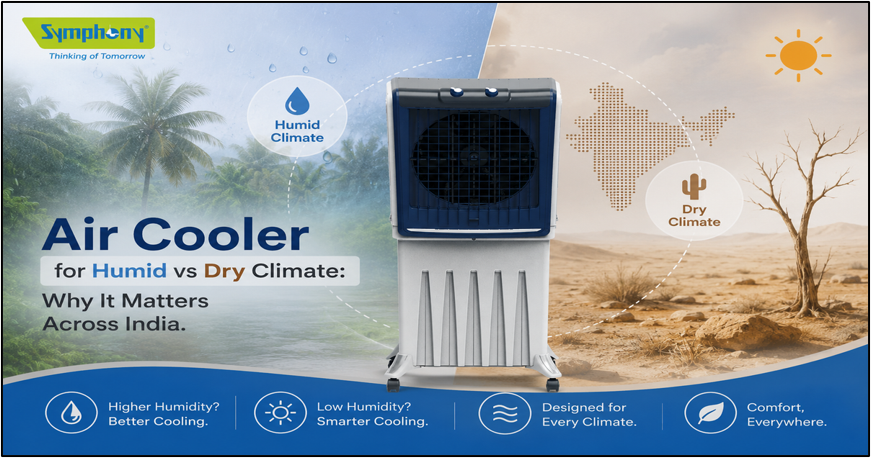
In case you have ever effectively utilized an air cooler in two distinct cities, you may have observed that it does not feel the same everywhere.
A desert air cooler typically gives better cooling in hot and dry weather, as the water inside it can evaporate at the rate of knots. Humid weather makes that harder.
The cooler will still blow air, but you may not feel the same drop in temperature. That is why people living in humid areas should also think about airflow, ventilation, or even tower fans such as Symphony Surround B and Surround-i.
Why does dry weather help an air cooler?
You do not need to know much science to understand this. For a second, think you have a wet towel, and you leave it outside on a hot and dry afternoon. It dries swiftly.
Try the same thing when the weather is sticky and damp, and it takes way too long. An air cooler faces the same problem.
The cooler comprises wet cooling pads. Due to the moisture present in the air, it cannot take in much more. This slows down the evaporation and also the cooling effect of the cooler.
This is also why checking only the day’s temperature can be misleading. Two cities may both be at 38°C, yet a cooler can feel far more effective in the city with drier air.
1. When does a desert cooler make sense?
A desert cooler is mainly useful when the weather is very hot and fairly dry. It is also usually meant for a bigger space than a small personal cooler.
For a second, think about a family that spends most of the afternoon in a single large living room. They may require stronger airflow and a larger tank, as the cooler will function continuously for a few hours. In that situation, a desert model makes sense.
For a small bedroom, things are different. Putting a huge cooler beside the bed does not automatically give you better comfort.
If you are searching for the best desert air cooler, look at the recommended room coverage first. Tank size matters, but it should come later.
2. Is a Large Desert Cooler always better?
No. A Large Desert Cooler is useful when there is actually a large area to cool. A hall, a wide living room, a shop, or a large work area are good examples.
A High Capacity Desert Cooler can also save you some effort if the machine runs for long hours. You will not need to refill the water tank frequently.
But this is where buyers sometimes get confused. More water capacity does not mean more cooling by itself.
A large tank only holds more water. The comfort level of the room will depend upon humidity, cooling pads, airflow, ventilation, and room size. Hence, buying the biggest cooler simply because there is space for it does not make it to be a smartest decision.
What happens when the weather turns humid?
The cooler does not stop working. It just behaves differently. You will still feel moving air. What you may not get is the same drop in temperature that you enjoyed in dry weather.
This often becomes noticeable when the monsoon arrives. A room that felt comfortable with an air cooler a few weeks earlier may suddenly start feeling damp. There is a simple thing worth checking before blaming the cooler: your windows.
Many of us automatically shut the windows when we switch on a cooling appliance. That works with an AC. It is not a wise call, particularly when you are operating an evaporative air cooler.
The cooler keeps adding air moisture; hence, that air needs space to move. This is where leaving a door or window partially open can allow fresh air to enter while damp and warmer air gets the space to move outside.
● Is a tower fan useful in humid weather?
Absolutely! Some evenings in summer are not very hot. However, they are not comfortable either, as the air barely seems to move. Your skin feels sticky, and the room feels stuffy to begin with.
Integrating more moisture may not be the best decision in such instances. A tower fan focuses on moving air rather than using wet cooling pads. Symphony, for example, has tower fans such as Surround B and Surround-i.
That does not make a tower fan “better” than an air cooler. They solve slightly different problems. Dry, intense heat is where evaporative cooling becomes useful. When humidity is very high, plain airflow can sometimes feel more pleasant.
How do you choose an Air cooler for Room use?
Commence by walking into the room that you wish to cool down. This seems to be an obvious thing; however, online shopping makes it easy to forget. Glance at the room size. Observe where sunlight enters during the hot afternoons.
See where you could place the cooler without blocking its back. Check whether a window is nearby. An air cooler for room use should match all of these things.
If you are buying a household air cooler that will move between rooms, portability matters as well. Wheels can be useful. So can a tank that is easy to fill and clean.
A family may keep the cooler in the living room during the hot days while shifting it into the bedroom at night. If that is the case, a huge model may prove to be a less impressive choice.
● Where should you keep an air cooler?
Near fresh air is usually a sensible place.
A window can work well because the cooler gets a regular supply of warm air to pull through its wet pads. Do not press the back of the cooler against the wall.
This is where the slightest movement of the cooler can prove magical in providing cool air. And remember the open-door rule. Air needs a way in and a way out.
Why does desert cooler prices vary so much?
You may notice a big difference in desert cooler price even between products that look fairly similar. There are several reasons for this. Tank capacity, room coverage, controls, body size, airflow, cooling pads, and other features can all affect the cost.
This makes price-only comparisons risky. Suppose one model costs less but is meant for a smaller room. It may look like the better deal until you use it in a large living area and find that the airflow never reaches the other side.
When comparing desert air cooler prices, first compare products made for similar room sizes. Then look at the other details.
What should you check before buying a desert air cooler online?
Buying a desert air cooler online makes comparison easy, but product photographs do not tell you much about actual size or suitability.
Check the dimensions. Check the recommended room coverage. Look at tank capacity, power use, and the type of cooling pads. Also think about something much less exciting: refilling.
● Where is the nearest tap?
If you need to carry buckets across the house every time the tank runs low, a larger capacity may suddenly become more useful than an extra electronic feature.
Maintenance matters too. A cooler needs regular cleaning, particularly around the tank and cooling pads. Easy access can save a fair amount of trouble over a long Indian summer.
Final Thoughts – Which cooler works best across India?
There is no one answer because Indian summers are not all alike.
If your weather is mainly hot and dry, a desert cooler can be a very practical way to make a room more comfortable. If you live in larger spaces, it requires greater room coverage and airflow.
In case you reside with high humidity, particularly during the monsoon or coastal summers, expect the cooling effect to be minimal. Ventilation here becomes more crucial. This is particularly the case with muggy days where you may opt for stronger circulation without extra moisture.
So, before looking at tank size, discounts, or features, check two things: the weather where you live and the room you actually want to cool.
Get those right first. Choosing the cooler becomes much easier after that.
