

You Used AI Before Breakfast. Several Times.
The public picture of artificial intelligence tends to involve robots, headlines, and the future. The actual picture is smaller, quieter, and already wrapped around your day: the inbox that swallowed the spam you never saw, the map that rerouted you around a jam you never sat in, the photo library that found “beach, 2019” in half a second, the streaming service that knew which series would eat your weekend. Artificial intelligence in everyday life is not coming; it has been resident for years, mostly invisible precisely because it works. This tour walks through the places AI already serves you — recommendations, navigation, communication, health, home, and money — with an honest eye on what it is actually doing there (pattern-matching at scale, not magic, not consciousness) and where its quiet competence ends. And as the technology shifts from chatbots to agents, the skills conversation is changing too; our own recent piece on the skill shift every tech professional should plan for picks up that thread.
Recommendations and Search: The Invisible Shop Assistants
The most familiar everyday AI is the recommender: the system that orders your video feed, queues your next song, suggests the product “frequently bought together” with the one in your basket, and decides which of your friends’ posts you see at all. Underneath, these are prediction engines trained on behaviour — yours and millions of similar people’s — answering one question in a hundred costumes: given everything clicked before, what is most likely to satisfy next? Search itself is now AI through and through: modern engines interpret intent rather than matching keywords (a query like “that Italian place near the station with the garden” is a comprehension test keyword search would fail), correct your spelling from context, and increasingly answer directly, summarising sources into a paragraph. The everyday consequences are double-edged and worth seeing clearly: convenience is real — your library, shop, and feed are genuinely shaped to your taste — but so is the bubble effect, where the predictor’s love of the familiar quietly narrows what you are ever offered. The practical literacy is simple: periodically search and browse against type, on purpose, to feed the machine better evidence about the breadth of your interests.
Maps, Language, and Communication: AI as Translator of the World
Navigation is AI’s most trusted daily performance: traffic prediction fuses live movement from millions of phones with history to route you around the city’s forming jams, and arrival estimates that are eerily accurate are pure machine learning wearing a map’s clothes. Language got the same treatment. Machine translation has moved from comedy to infrastructure — menus, contracts, and conversations cross languages in your pocket in real time — and the large language models behind chatbots now draft, summarise, and rephrase your own words on demand: the email softened, the report condensed, the meeting turned into action points. Communication hygiene is the third invisible service: spam and phishing filters are classification AIs in permanent arms race with the fraud AIs opposite them, and your call-screening assistant and message summaries are the same technology on your side of the line. None of this requires your attention, which is the point — the most successful everyday AI is the kind you only notice on the rare day it is switched off, when the spam floods back and the map goes dumb.
Home, Health, and Money: The Quiet Specialists
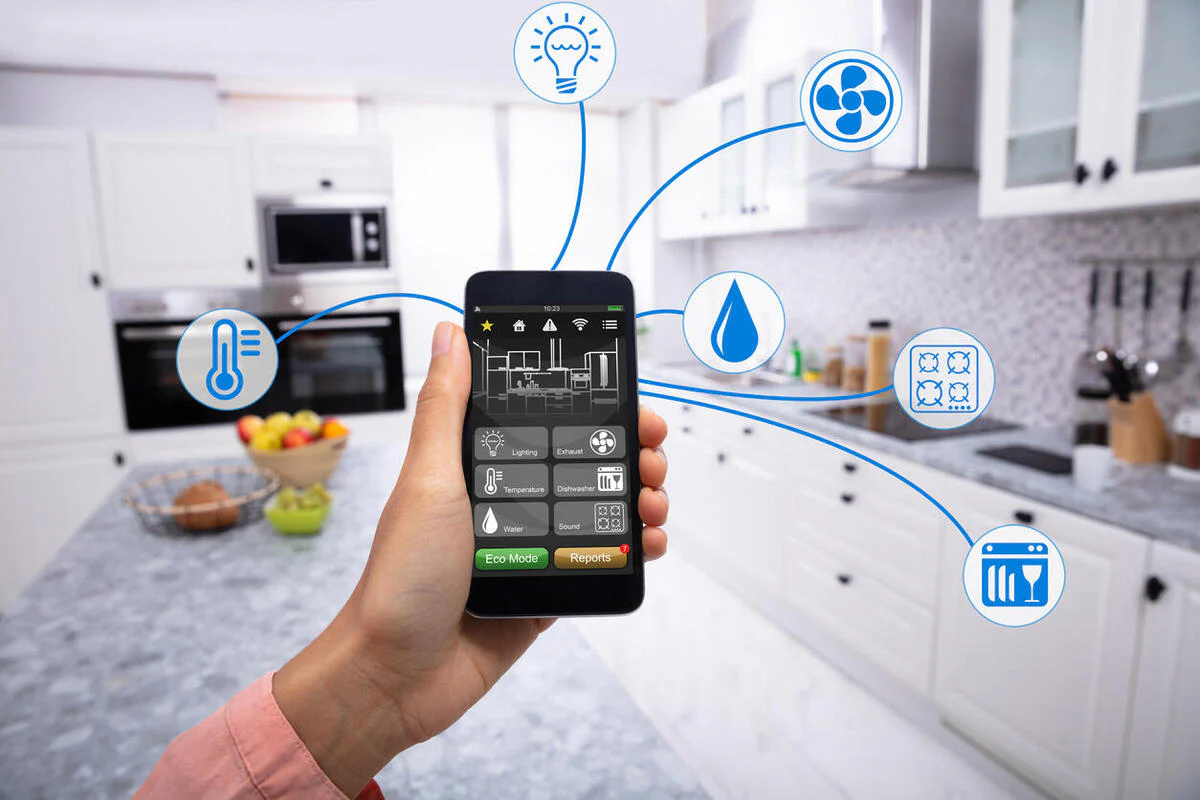
Domestically, AI runs the thermostat that learned your evenings, the vacuum that maps your flat rather than bumping through it, the doorbell that distinguishes a courier from a passer-by, and the photo app quietly building albums of your children by face — a sentence that would have read as science fiction in 2005 and as a settings page in 2025. Health wears it too: watches that estimate sleep stages, flag irregular heart rhythms, and count your recovery are running models on your wrist; symptom-checkers and appointment systems triage with models behind the desk; and fitness apps adapt plans to your actual completion history rather than a printed ideal. Money might be the deepest embed: fraud detection scores every card transaction in milliseconds against your personal pattern (and occasionally embarrasses you on holiday for it), credit decisions and insurance quotes are modelled, and budgeting apps categorise your spending with the same classifiers that sort your email. Even your phone’s camera is an AI product — the portrait blur, the night mode, the “best shot” selection are computed, not merely captured. Choosing that hardware well matters, incidentally, which our guide on how to choose a smartphone covers from the buyer’s side.
What It Isn’t (Yet), and How to Live With What It Is
Honesty requires the boundary lines. Today’s everyday AI is spectacular pattern recognition, not understanding: it predicts the likely word, click, route, and risk without knowing what any of them mean, which is why it can summarise a contract beautifully and also invent a clause with identical confidence. It is trained on the past, so it encodes the past’s biases (hiring and lending models have required legal correction for exactly this), and it is only as private as the company collecting the behaviour it learns from. The sane everyday posture is neither fear nor worship but supervision: enjoy the automation for low-stakes convenience, verify where consequences live (money, health, law, anything you sign), keep a human route open for the decisions that matter, and adjust the privacy dials you are given rather than accepting every default. Do that, and the picture resolves into something un-dramatic and rather wonderful: a layer of tireless, narrow, occasionally wrong assistance woven through ordinary life — answering before breakfast, and best appreciated with your eyes open.
