

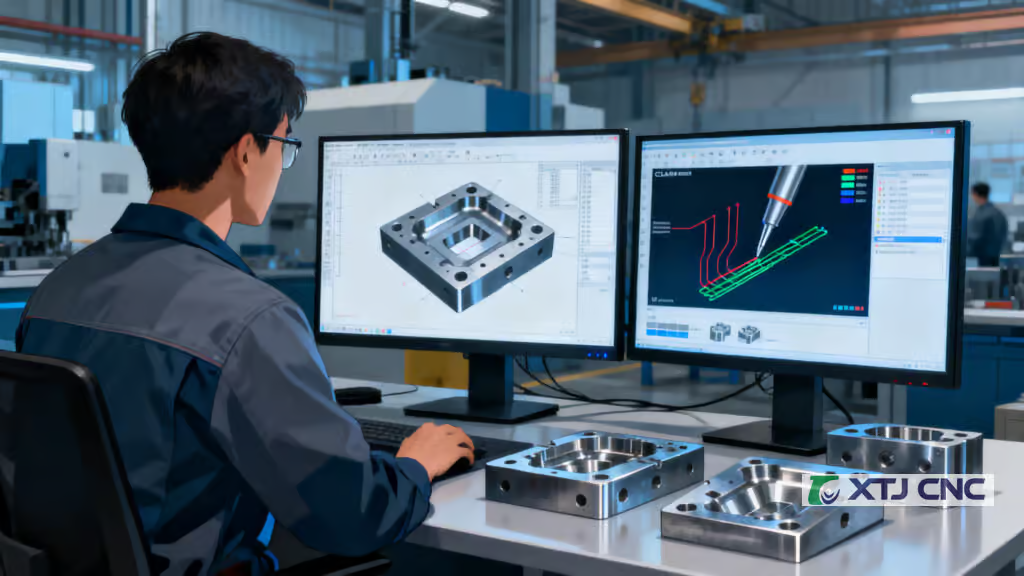
Tooling is the foundation of metal stamping. Before a single part rolls off a press, an enormous amount of engineering work goes into the die design and build process. The quality, precision, and durability of the tooling determine the dimensional accuracy of every part produced, the speed at which production can run, and the cost per unit across the life of a program. For manufacturers that rely on stamped metal components, understanding what a strong die design and build program looks like is essential to making informed decisions about supplier selection, tooling investment, and production planning.
What Die Design and Build Involves
The die design and build process begins long before any steel is cut. Engineering teams analyze the part geometry, identify the forming operations required, and develop a strip layout that sequences those operations across multiple stations in the die. Each station performs a specific function: blanking a slug, piercing a hole, bending a flange, forming a contour, or trimming a profile. The goal is to arrive at a complete part geometry by the time the strip exits the last station, with every feature within tolerance and the part free from defects.
Once the strip layout is approved, detailed die component drawings are generated for every punch, die block, stripper plate, guide, and assembly component in the tool. These drawings go to the tool room, where skilled machinists produce each component using CNC machining, grinding, and wire EDM. The components are then assembled, trialed, and adjusted until the die produces parts that meet specification consistently.
Progressive Die Design: Engineering for Speed and Repeatability
Progressive dies are the dominant tool type for high-volume metal stamping. In a progressive die, a metal strip is indexed through the tool one step at a time, with each index advancing the strip by one station pitch. By the time any given section of strip has passed through all stations, it has been transformed from flat sheet into a finished part. This continuous-flow approach is what allows progressive stamping presses to run at hundreds of strokes per minute while maintaining dimensional precision.
The quality of progressive die design determines how well the tool performs at those speeds. Strip guidance and pilot systems must keep the material positioned accurately at every station. Punch and die clearances must be sized correctly for the material type and thickness to produce clean shear edges without excessive burr or secondary cracking. Spring forces must be balanced to control stripping and prevent tool damage during high-speed cycling. These are not simple calculations, and they require experienced die designers with deep knowledge of material behavior and press dynamics.
Strip Layout and Material Utilization
One of the most consequential decisions in progressive die design is the strip layout, specifically how parts are oriented and nested on the material strip. A layout that minimizes scrap can save significant material costs over the life of a program. At the same time, the layout must accommodate all the forming operations in a logical sequence without creating interference between stations or leaving insufficient web material to guide the strip reliably through the tool.
Experienced die design and build teams use CAD software to evaluate multiple layout options and balance material utilization against tooling complexity and production risk. Simulation tools can predict spring-back, thinning, and forming forces before any tooling is produced, reducing the number of trial iterations required to achieve a passing first article.
Tolerancing and Fit-Up
Punch-to-die clearance is a critical parameter in any stamping tool. Too little clearance creates excessive punch wear and can cause galling. Too much clearance produces ragged shear edges and increases burr height. The correct clearance depends on material type, material thickness, tensile strength, and the specific operation being performed.
In a custom die build, these clearances are machined to tight tolerances and then verified during assembly using plug gauges, optical comparators, or CMM equipment. The fit-up between mating components in the die must also be controlled to prevent excessive slop that could allow components to shift under load. Precision here translates directly to part consistency in production.
What Custom Die Build Services Include
The custom die build process encompasses far more than machining steel to drawings. A complete die build program typically includes initial design consultation, design for manufacturability review, material selection, component machining, heat treatment coordination, assembly, tryout, and first article validation. Some tool builders also offer engineering support during production ramp-up to identify and address any die performance issues that emerge as speeds increase.
The specific services offered vary by toolmaker, but the most capable die design and build operations maintain all critical manufacturing processes in-house. This means CNC machining centers, surface and cylindrical grinding, wire EDM and sinker EDM, and dedicated assembly and tryout presses are all on-site. In-house capability eliminates the lead time and quality variability that comes from outsourcing components to multiple suppliers.
Why Tooling Quality Is a Long-Term Investment
It is tempting to evaluate custom die build proposals on initial cost alone. A lower quote may be attractive, but tooling that performs poorly in production creates costs that far exceed any upfront savings. Dies that require frequent maintenance, produce high scrap rates, or run at reduced speeds significantly inflate the per-unit cost of parts over the life of the program.
A well-engineered progressive die, built from quality tool steel with proper heat treatment and surface finishing, can run millions of strokes before requiring major maintenance. The progressive die design choices made early in the program, including station sequencing, component material selection, and wear surface specifications, determine how long the tool remains productive and how much maintenance it requires along the way.
When evaluating a die design and build partner, look at the quality of their tool steel sourcing, their heat treatment processes, and the surface finish specifications they apply to critical forming surfaces. These details are often not visible in a quote but reveal a great deal about the level of engineering rigor behind the product.
Communication and Engineering Collaboration
The best custom die build relationships are collaborative. Toolmakers who engage early in the part design process can often identify geometric features that are difficult to stamp reliably and suggest modifications that preserve the design intent while improving manufacturability. This upstream collaboration reduces tooling iterations, shortens time to production, and results in a more capable and durable tool.
Look for a die design and build partner who treats the engineering review process as an opportunity to add value, not just a formality before cutting steel. Toolmakers who ask thoughtful questions about application requirements, material options, and production volumes are likely to produce better outcomes than those who simply convert a print into tooling without deeper engagement.
Working with a Vertically Integrated Tooling Partner
For manufacturers who need both tooling and production stamping, working with a partner who integrates die design and build with high-speed stamping production offers significant advantages. The tooling team and the production team share the same facility, the same equipment, and the same quality standards. When a die needs adjustment, the change is made and validated in the same press that runs production. There is no handoff friction, no logistics delay, and no ambiguity about accountability.
Companies like Composidie offer fully integrated progressive die design and custom die build services alongside high-speed production stamping. This means customers get a single partner responsible for tooling performance from the first prototype through high-volume production.
Conclusion
Strong die design and build capabilities are what separate manufacturers who can reliably produce precision stamped parts at volume from those who struggle with consistency and yield. Investing in progressive die design done right, with experienced engineers, in-house machining, and rigorous tryout processes, and partnering with a team that delivers high-quality custom die build services, sets the foundation for a successful long-term manufacturing program.
