

Hair restoration has evolved significantly over the last decade. While topical treatments such as Minoxidil continue to be widely used, advances in regenerative medicine have introduced a new generation of therapies designed to support the biological processes involved in healthy hair growth.
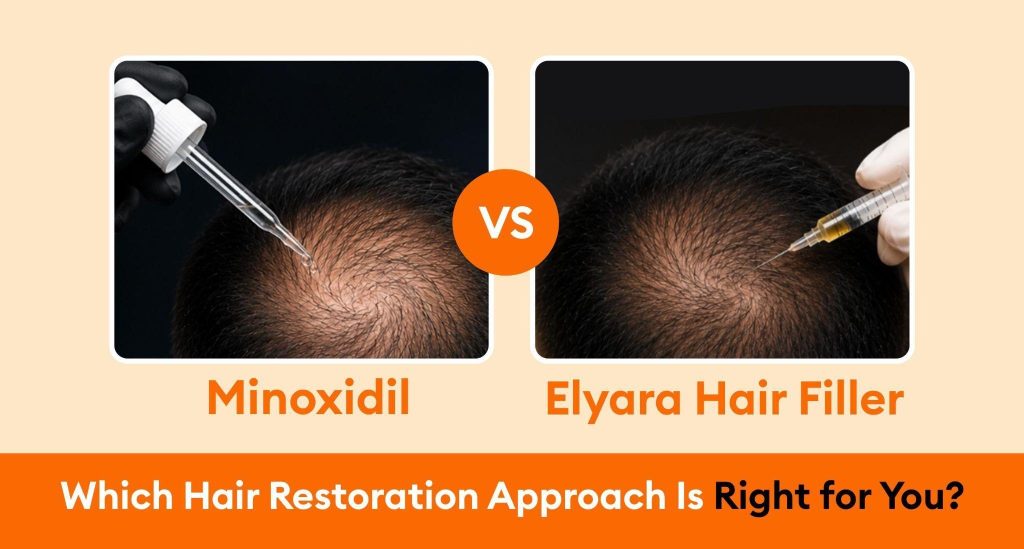
One of the latest innovations is Elyara Hair Filler, a CE-marked regenerative hair filler developed specifically for hair regrowth and scalp reconstruction. Unlike traditional topical treatments, Elyara combines seven patented biomimetic peptides with hyaluronic acid and advanced double-encapsulation technology to deliver sustained peptide release following treatment. Rather than relying on a single mechanism, it was designed to support multiple biological pathways involved in follicular activity, hair growth, scalp regeneration, and tissue repair.
Minoxidil, on the other hand, has been one of the most recognized hair loss treatments for decades. It is typically applied daily as a topical medication and remains a common first-line treatment for androgenetic hair loss.
Although both treatments are used to support hair restoration, they are fundamentally different in how they work, how they are administered, and the biological pathways they target.
Quick Comparison
| Feature | Elyara Hair Filler | Minoxidil |
| Treatment Type | Regenerative injectable hair filler | Topical medication |
| Technology | 7 patented biomimetic peptides + hyaluronic acid | Vasodilator-based |
| Primary Focus | Multi-pathway regenerative signalling | Blood flow support |
| Wnt/β-catenin Support | Targets pathways associated with Wnt signalling | Not a primary mechanism |
| DKK-1 & BMP4 Regulation | Designed to support these pathways | Not specifically targeted |
| Sustained Release | Double-encapsulation technology | No |
| Administration | Practitioner-administered | Self-applied daily |
| Treatment Frequency | Structured clinical protocol | Daily application |
| Daily Commitment | No | Yes |
| Downtime | Minimal | None |
What Is Elyara Hair Filler?
Elyara Hair Filler is a CE-approved regenerative injectable treatment developed specifically for hair regrowth and scalp reconstruction.
The formulation combines seven patented biomimetic peptides with a hyaluronic acid carrier using advanced double-encapsulation technology, allowing peptides to be gradually released into the scalp for approximately two weeks after treatment. This sustained-release approach is designed to maintain peptide activity around the hair follicle for longer than an immediate-release formulation.
Unlike conventional treatments that focus on a single biological mechanism, Elyara was developed around the understanding that hair growth is regulated by multiple interconnected signalling pathways.
The treatment is designed to support biological processes associated with:
- Hair growth activation
- Hair cycle regulation
- Follicular stem-cell activity
- Wnt/β-catenin signalling
- Scalp regeneration
- Extracellular matrix support
- Tissue renewal
- Protection against follicular miniaturization
Treatment is performed by trained practitioners as part of a structured clinical protocol tailored to the patient’s needs.
How Elyara Hair Filler Works
Hair loss is far more complex than simply reduced blood circulation to the scalp.
Research has shown that progressive hair thinning involves multiple molecular pathways that regulate how hair follicles grow, regenerate, and eventually miniaturize over time. Among the most important are the Wnt/β-catenin pathway, BMP4, DKK-1, extracellular matrix signalling, follicular stem-cell activity, and growth factor regulation.
Elyara was developed around this modern understanding of hair biology.
Instead of targeting one pathway alone, it combines seven biomimetic peptides that work together to support several biological mechanisms involved in healthy follicular function.
The formulation can be viewed as three complementary systems working together:
Hair Growth Activation
Several peptides—including CG-Rehairin, CG-Edrin, and CG-Wint—are designed to support Wnt/β-catenin signalling, one of the key molecular pathways associated with activating the anagen (growth) phase of the hair cycle and promoting follicular activity.
Hair Loss Inhibition
Hair loss associated with androgenetic alopecia involves increased activity of signalling molecules such as BMP4 and DKK-1, both of which suppress Wnt signalling and contribute to follicular miniaturization.
CG-Nokkin is designed to inhibit BMP4 receptor activity while suppressing DKK-1 synthesis, supporting biological pathways associated with healthier follicular function.
Structural Support and Scalp Regeneration
Healthy hair follicles depend on more than signalling molecules—they also require a supportive extracellular environment.
Peptides such as CG-Prohairin β4, CG-Seperin, and CG-Keramin-2 are designed to support follicular stem-cell activity, collagen production, fibroblast proliferation, tissue renewal, and extracellular matrix integrity, helping create an environment that supports healthy hair growth.
Together, these mechanisms form a regenerative platform that supports multiple aspects of follicular biology rather than relying on a single biological target.
Why Biomimetic Peptides Matter
Biomimetic peptides are laboratory-designed molecules that mimic naturally occurring signalling proteins within the body.
Rather than acting as medications, they communicate with cells by supporting biological processes involved in tissue repair, regeneration, and follicular activity.
Elyara combines seven patented biomimetic peptides, each selected to support a different aspect of hair biology.
Among the pathways supported are:
- Wnt/β-catenin activation, associated with initiating the hair growth cycle.
- BMP4 and DKK-1 regulation, supporting pathways linked to androgenetic alopecia.
- Follicular stem-cell activation, helping maintain healthy follicular function.
- Extracellular matrix support, contributing to the structural environment surrounding hair follicles.
- Collagen production and tissue renewal, supporting scalp quality.
- Growth factor signalling, involved in follicular communication and regeneration.
This multi-pathway approach reflects the growing shift in regenerative medicine toward supporting the biological environment surrounding the follicle rather than focusing on a single target.
What Preclinical Research Shows
During product development, Elyara’s proprietary peptide complex was evaluated in a series of laboratory studies comparing the peptide formulation with untreated controls and a Minoxidil comparator.
While laboratory findings should not be interpreted as direct clinical outcomes, they help demonstrate how the peptide platform influences biological processes associated with hair growth under controlled conditions.
Greater Dermal Fibroblast Proliferation
One in-vitro study demonstrated that the peptide complex increased human hair dermal fibroblast proliferation to 129%, compared with 113% observed in the Minoxidil comparator group after 72 hours.
Dermal fibroblasts contribute to maintaining the structural environment surrounding healthy hair follicles.
Increased Dermal Matrix Cell Activity
Researchers also observed increased proliferation of human hair dermal matrix cells following treatment with the peptide complex compared with Minoxidil.
These cells play an important role during the anagen phase of hair growth.
Improved Collagen Expression
The peptide complex demonstrated increased Type I collagen expression compared with both untreated controls and the Minoxidil comparator.
Collagen forms part of the extracellular matrix that provides structural support around the hair follicle.
Hair Keratin Gene Expression
The peptide complex increased the expression of Keratin-14 and Ha3-II, two genes involved in hair shaft formation and follicular differentiation. These proteins play an important role in developing healthy hair fibres and maintaining follicular structure.
Growth Factor Expression
In laboratory studies, the peptide complex increased expression of several growth factors associated with the anagen (growth) phase of the hair cycle, including:
- HGF (Hepatocyte Growth Factor)
- IGF-1 (Insulin-like Growth Factor-1)
- VEGF (Vascular Endothelial Growth Factor)
These signalling molecules are involved in follicular communication, angiogenesis, and regulation of the hair growth cycle.
Support Against DHT-Mediated Hair Loss
One of the key molecular drivers of androgenetic alopecia is DKK-1, a protein stimulated by DHT that suppresses Wnt signalling and contributes to follicular miniaturization.
In preclinical testing, Elyara’s peptide complex reduced DKK-1 gene expression under DHT stimulation when compared with the control group, supporting biological pathways associated with healthier follicular function.
Follicular Protection and Regeneration
Additional ex-vivo studies demonstrated that the peptide complex:
- Protected hair follicles from DKK-1-induced degeneration.
- Supported the formation of new hair placodes.
- Maintained Wnt and β-catenin expression even under DKK-1 challenge.
- Demonstrated greater hair shaft elongation when the complete peptide complex was used compared with individual peptides alone.
Together, these findings highlight Elyara’s multi-pathway regenerative design, targeting not just hair growth but also the biological environment required for healthy follicular function.
What Is Minoxidil?
Minoxidil is one of the most widely used topical treatments for hair loss.
Originally developed as a medication for high blood pressure, researchers observed increased hair growth as a side effect, which eventually led to the development of topical Minoxidil formulations for androgenetic alopecia.
Today, it is commonly used for:
- Male pattern hair loss
- Female pattern hair loss
- Diffuse thinning
- Maintenance of existing hair density
Minoxidil is typically applied once or twice daily and is generally intended for continuous long-term use. Because its benefits depend on ongoing application, discontinuing treatment may result in gradual loss of the improvements achieved over time.
Elyara Hair Filler vs Minoxidil
Although both treatments aim to support hair growth, they are built on very different scientific principles.
Minoxidil is generally understood to support hair growth primarily through improved blood flow around hair follicles. It has been used successfully for decades and remains one of the most established non-surgical treatments available.
Elyara Hair Filler represents a newer regenerative approach.
Instead of relying primarily on a single mechanism, it combines seven biomimetic peptides with sustained-release technology to support multiple biological pathways involved in hair growth, including:
- Wnt/β-catenin signalling
- Hair cycle regulation
- Follicular stem-cell activity
- DKK-1 and BMP4 regulation
- Extracellular matrix support
- Collagen production
- Growth factor signalling
- Scalp regeneration
Another important distinction is treatment commitment.
Minoxidil requires consistent daily application, often over many months or years, to maintain its effects. Elyara, on the other hand, is administered by trained practitioners according to a structured treatment protocol and does not require a daily home application routine.
For patients who prefer a practitioner-led regenerative treatment rather than ongoing daily maintenance, this may be an important consideration.
Which Treatment May Be Right for You?
Both treatments have a role within modern hair restoration, and the most appropriate option depends on the individual’s pattern of hair loss, treatment goals, and clinical assessment.
Minoxidil may be suitable for individuals who:
- Prefer a home-based treatment.
- Are comfortable applying a topical product every day.
- Want a non-procedural option.
- Are beginning treatment for early-stage hair thinning.
Elyara Hair Filler may be suitable for individuals who:
- Are interested in regenerative medicine.
- Prefer a practitioner-administered treatment.
- Want a peptide-based approach designed around multiple biological pathways.
- Are looking for advanced non-surgical hair restoration.
- Wish to support both scalp quality and follicular health.
A qualified healthcare professional can help determine which treatment or combination of treatments is most appropriate based on individual needs.
Final Thoughts
Hair restoration has progressed considerably beyond traditional topical therapies.
While Minoxidil remains one of the most established and widely used treatments for hair loss, advances in molecular biology have expanded our understanding of the complex biological processes that regulate hair growth.
Elyara Hair Filler reflects this evolution by combining seven patented biomimetic peptides, double-encapsulation sustained-release technology, and hyaluronic acid into a regenerative treatment designed to support multiple signalling pathways associated with follicular health and scalp regeneration. Rather than focusing on a single mechanism, it was developed around the modern understanding that healthy hair growth depends on a network of interconnected biological processes.
As regenerative aesthetics continues to advance, peptide-based platforms such as Elyara are helping shape the next generation of non-surgical hair restoration.
Frequently Asked Questions
Is Elyara Hair Filler the same as Minoxidil?
No. Minoxidil is a topical medication applied daily, while Elyara Hair Filler is a CE-approved injectable regenerative treatment administered by trained practitioners.
Can Elyara Hair Filler replace Minoxidil?
Treatment recommendations vary from person to person. Some individuals may benefit from one treatment, while others may be advised to combine different therapies as part of a personalised hair restoration plan.
What makes Elyara different from Minoxidil?
Minoxidil primarily supports hair growth through a vasodilator-based mechanism and requires daily application. Elyara combines seven biomimetic peptides with sustained-release technology to support multiple biological pathways involved in hair growth, follicular signalling, and scalp regeneration.
Why are biomimetic peptides important in hair restoration?
Biomimetic peptides are designed to mimic naturally occurring signalling molecules in the body. They can support biological pathways involved in follicular activity, tissue repair, hair cycle regulation, and scalp health, making them an increasingly important area of regenerative medicine.
Which treatment uses newer technology?
Minoxidil has been used clinically for decades and remains an established treatment option. Elyara Hair Filler represents a newer generation of regenerative hair restoration technology built around advances in peptide science, sustained-release delivery systems, and multi-pathway biological support.
